
Renault Espace F1 '95
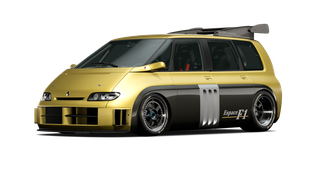
- Performance Point
- PP 758.58
- Group
- Gr.X
- Max Power
- 799 BHP / - rpm
- Max Torque
- 71.9 kgfm / - rpm
- DriveTrain
- MR
- Aspiration
- NA (Naturally Aspirated)
- Displacement
- 3,500 cc
- Manufacturer
- Renault
- Length
- 4,430 mm
- Width
- 2,050 mm
- Height
- 1,773 mm
- Weight
- 1,300 kg
Renault Espace F1 '95: The Ultimate Minivan Supercar Fusion
The Renault Espace F1 '95 is a unique and unforgettable creation, blending the practical world of family minivans with the raw power and engineering prowess of Formula 1 technology. Introduced as a concept in 1995 to celebrate both the tenth anniversary of the original Espace and Renault’s involvement in Formula 1, the Espace F1 is not just a piece of automotive whimsy, but a statement of what can be achieved when innovation and creativity collide.
At its core, the Renault Espace F1 was a partnership between Matra (the original producer of the Espace), Renault Sport, and Williams Formula 1. They replaced the standard minivan's modest drivetrain with the 800-horsepower 3.5-liter V10 engine from Renault’s championship-winning Formula 1 car. The entire chassis was re-engineered using a carbon fiber monocoque, and F1-grade brakes, suspension, and even active aerodynamics were installed. The result was an astonishing vehicle capable of reaching 100 km/h in just 2.8 seconds—performance numbers on par with the era’s finest race cars, but housed in the body of a family MPV.
While the Espace F1 was never intended for mass production, nor was it homologated for any racing series, it made a lasting impression on both the automotive industry and car enthusiasts. It made television and motorsport demo appearances, famously featuring in high-profile demonstrations and captivating audiences with the sheer absurdity of its performance. The Espace F1 also gained renewed fame and virtual immortality as a beloved fantasy car in video games like the Gran Turismo series, introducing new generations to the wildest minivan ever created.
The Renault Espace F1 '95 remains a symbol of Renault’s technical daring and creative spirit. While it never raced in a traditional sense, its existence celebrates both Renault’s racing prowess and their reputation for boundary-pushing innovation in automotive design. There has never been another minivan like it—and there likely never will be.